
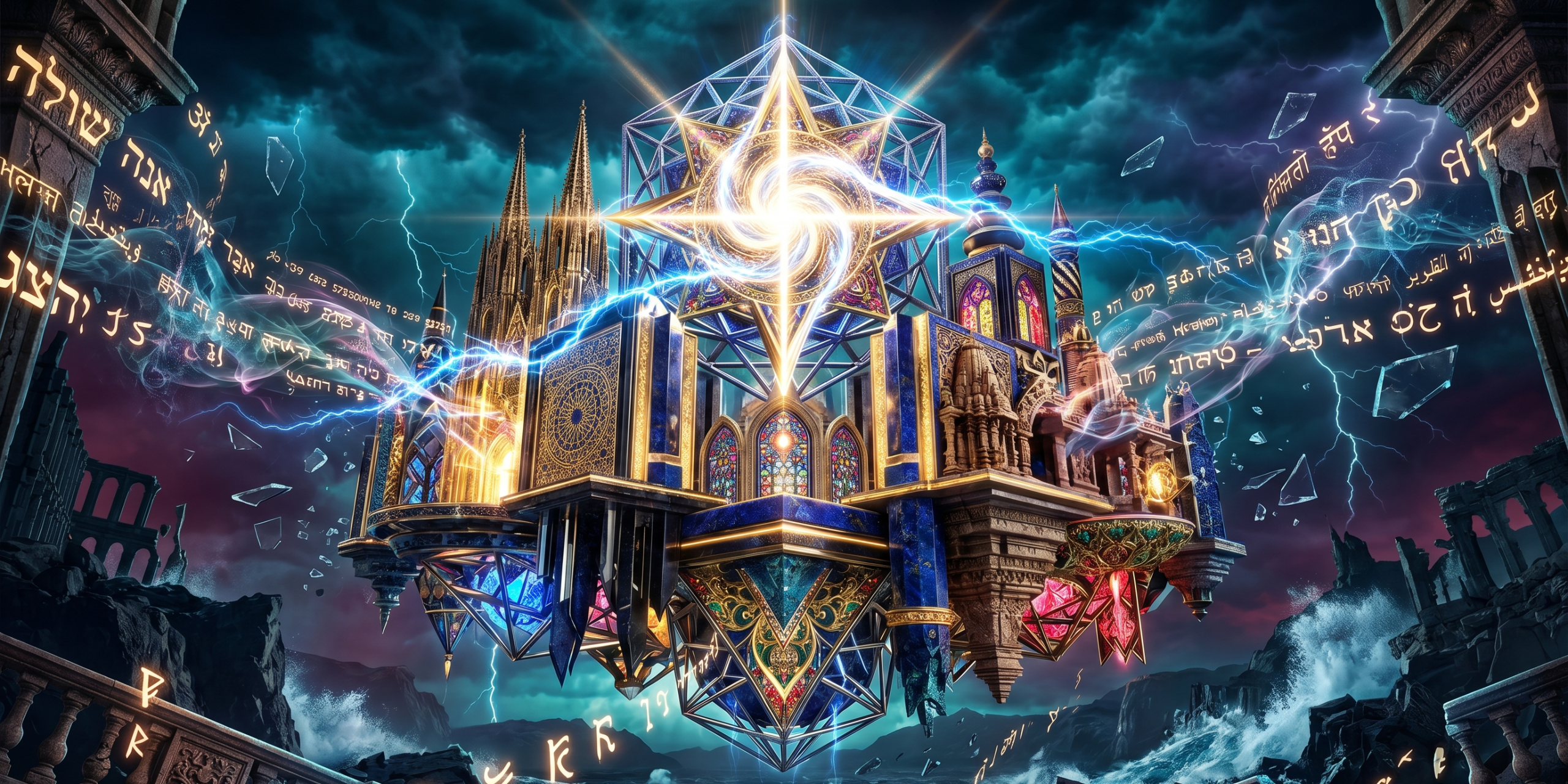
The Problem Statement: The Collapse of Brittle Belief
Most individuals possess a “spiritual floor” made of glass. Their belief systems are either inherited dogmas they don’t understand or “fair-weather” optimistic platitudes that shatter the moment they encounter a high-entropy event—a market crash, a personal betrayal, or a systemic crisis. This is Brittle Faith. It is a liability because it provides a false sense of security during periods of low stress, only to leave the operator completely unsupported when the load increases.
A sovereign operator recognizes that “Faith” is not a mystical feeling or a blind adherence to the unprovable. In a technical sense, Faith is a Strategic Placeholder for Incomplete Data. It is the structural assumption that allows you to maintain decisional velocity in the dark. The Faith Architecture is the engineering of this placeholder. It is the process of building a framework that is logically grounded yet capable of supporting the weight of the unknown.
Comparative Analysis: Blind Belief vs. Faith Architecture
Phase I: The Foundational Slab (Verified Logic)
The Faith Architecture does not begin with the unseen; it begins with the Known. You cannot build a bridge into the unknown if your anchor points are made of sand.
- The Verified History: You audit your own history of survival and success. You identify the “Constant Variables” that have allowed you to prevail in the past—your discipline, your logic, your resilience. This is the “Hardened Data” that forms the base of your architecture.
- The Probability Engine: You don’t “hope” things will work out; you calculate the probability of success based on your current inputs. Your faith is the Logical Extension of these probabilities into the future. You have faith in the process because the process is built on first principles.
- The Non-Negotiable Axioms: You anchor the architecture in the laws of reality (e.g., reciprocity, cause and effect). Your faith is the assumption that these laws will continue to function even when you cannot see the immediate outcome.
Phase II: The Structural Frame (Strategic Assumptions)
Once the foundation is set, you build the “Frame” that spans the gap of the unknown. These are your Operational Assumptions.
Assumption A: The Infinite Game Compatibility.
You assume that the universe—or at least the systems within which you operate—favors long-term, high-integrity players. You act as if this is a physical law, which allows you to reject short-term, low-integrity wins without hesitation.
Assumption B: The Anti-Fragility of Conflict.
You assume that every obstacle is a “Stress-Test” designed to harden your architecture. Instead of fearing the storm, you assume the storm contains the data required for your next upgrade.
- The Load-Bearing Intent: You define your “Primary Mission.” Your faith is the conviction that as long as your actions are aligned with this mission, the “Unseen Variables” will eventually resolve in your favor. This is not “Magic”; it is the recognition that Aligned Intent creates its own Gravity.
Phase III: The Reinforcement (Active Integrity)
The final layer of the architecture is the Reinforcement. This is the “Steel” that prevents the frame from buckling under the pressure of the market’s noise and the ego’s fear.
- The Integrity Loop: Faith is maintained through action. Every time you act in accordance with your architecture—especially when it’s difficult—you “Weld” a new joint. Your faith in the system grows because you are proving the system works in real-time.
- The Decoupling of Result: You separate your internal stability from the immediate external outcome. You have faith in the Maneuver, not the Score. If the maneuver was logically sound and high-integrity, the architecture is successful, regardless of the localized market reaction.
- The Recursive Audit: You do not allow your faith to become stagnant. Every week, you perform a “Structural Review.” Does the data still support the assumption? If the unknown has become known, you incorporate that data into the foundation and extend the frame further.
Operational Status: The Result of a Hardened Architecture
When the Faith Architecture is fully operational, the seeker achieves a state of Absolute Orientation. You no longer experience “The Fog of the Unknown” as a threat. Instead, you see it as “Unprocessed Potential.”
- Immunity to Cynicism: Cynicism is the defense mechanism of the brittle. The Sovereign doesn’t need cynicism because they have a structure that can handle the truth of the world without collapsing.
- Supreme Decisional Courage: Because you have a framework for the unknown, you can take risks that others find terrifying. You aren’t “gambling”; you are moving through a space that your architecture has already mapped and braced.
- The Gravity of the Monolith: A person with a hardened faith architecture acts as a “Fixed Point” for others. In a world of panic and shifting sands, your stability becomes a high-value asset.
Conclusion: The Mandate of the Builder
The world is full of “Believers” who fall apart when the lights go out. They have opinions, they have hopes, but they have no structure. They are the first to defect and the first to fail.
The sovereign operator is an Architect. You don’t “have” faith; you build it. You weld the logic of the past to the assumptions of the future, and you reinforce it with the steel of your daily integrity. Stop looking for a “sign” that the world is on your side. Build a system that ensures you are on the side of reality. When the architecture is sound, the unknown is no longer a prison—it’s your territory.
Anchor the logic. Frame the unknown. Weld the integrity.







Leave a Reply