
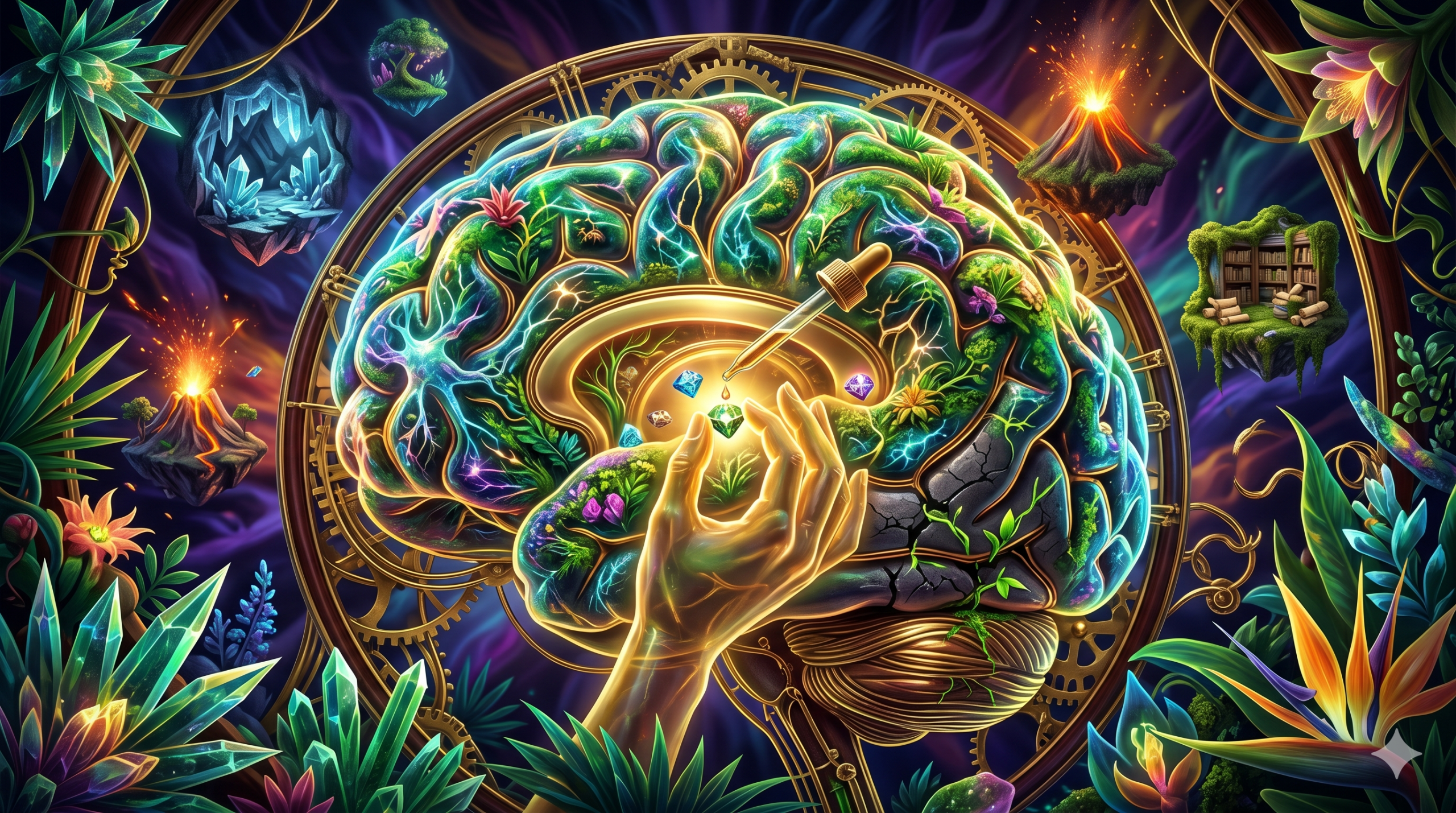
In the industrial era, we viewed the human mind as a machine—a predictable assembly of gears and levers that could be optimized through sheer force and linear efficiency. In the early digital age, we upgraded that metaphor to a computer—a processor that required more RAM and better software to handle the rising data load. But as we stand in 2026, navigating a world defined by hyper-complexity and non-linear shifts, both metaphors have reached their breaking point. A machine breaks under stress; a computer crashes when overloaded. Neither can truly grow. To thrive in this volatile landscape, you must adopt a more sophisticated, biological model: The Cognitive Garden.
Your mind is not a static piece of hardware; it is a living, breathing ecosystem. It is a collection of delicate internal climates, diverse thought-patterns, and deeply rooted habits that respond dynamically to the “nutrients” you provide and the “toxins” you allow to enter. Nurturing this ecosystem requires a shift from mechanical “fixing” to biological “tending.” It involves the strategic management of your environment, the ruthless pruning of non-essential obligations, and the patience to respect your natural cognitive seasons. When you master the art of the Cognitive Garden, you move beyond mere productivity and into a state of Systemic Flourishing.
The Soil: Engineering Your Environmental Foundation
In horticulture, the quality of the fruit is determined by the quality of the soil long before the seed is even planted. In the professional world, your “soil” is your environment—the physical, digital, and social context in which your mind operates. If your soil is depleted—cluttered with digital noise, toxic social dynamics, and a lack of recovery—no amount of “grit” will produce high-yield results.
Designing your environmental foundation requires a clinical audit of your daily inputs. You must treat your attention as the most valuable resource in the ecosystem. Every notification, every low-fidelity meeting, and every reactive scroll is a nutrient-leeching weed that prevents your high-level strategy from taking root.
- Digital Hygiene: In 2026, the “Attention Economy” has become an “Attention Extraction” industry. You must build a digital fortress around your focus. This means absolute sovereignty over your notification settings, a ruthless filter on your information intake, and a commitment to “Analog Windows” where the system can reset.
- Social Biodiversity: Your professional network is the “Mycelial Network” of your garden. Some nodes provide high-fidelity data and energy; others act as parasites, draining your bandwidth with “status games” and unnecessary drama. Prune the parasitic nodes to allow the generative ones to flourish.
- Physical Calibration: Your brain is a biological organ. It requires high-quality light, movement, and specific metabolic inputs. If the physical environment is stale, the cognitive output will be equally stagnant.
The Art of Strategic Pruning
The most difficult lesson for the high-achiever to learn is that growth requires death. In a physical garden, if you allow every bud to grow, the plant becomes “leggy” and produces small, sour fruit. To produce the prize-winning harvest, the gardener must ruthlessly prune away the “good” to make room for the “great.”
In your career, pruning is the art of the strategic “No.” It is the realization that your cognitive bandwidth is finite. If you are spread across twenty projects, you are merely “busy.” If you are concentrated on three, you are “deadly.” Pruning requires the courage to walk away from opportunities that are profitable but misaligned with your long-term trajectory. It is the clinical elimination of “The Middle”—those tasks that are important enough to distract you but not important enough to define you.
Operational Insight: Professional stagnation is rarely caused by a lack of opportunity; it is usually caused by an accumulation of “Opportunity Debt”—too many commitments that prevent you from doubling down on your most potent edge.
Nutrients: Managing the Information Diet
We are currently the most “over-fed” but “under-nourished” generation in history. We consume thousands of data points a day—headlines, tweets, pings—but very little of it translates into deep, actionable knowledge. In the Cognitive Garden, this is the equivalent of feeding your plants pure sugar: you get a temporary spike of growth (activity) followed by a catastrophic crash (burnout).
High-fidelity growth requires Nutrient Density. This means shifting from “Information Consumption” to “Knowledge Synthesis.” You must trade the “snackable” content for the “long-form” architecture. This involves deep reading, cross-domain study, and the “Boring Work” of sitting with a problem until it reveals its structural flaws.
- The Synthesis Filter: Never consume information without a “hook.” Ask: “How does this change my current decision-making framework?” If it doesn’t change anything, it’s just digital noise.
- Cross-Pollination: Intentionally seek out data from outside your primary niche. If you are a financier, read about architectural biology. If you are a coder, read about 18th-century military strategy. True innovation happens at the intersection of diverse “thought-species.”
- Active Composting: Use your failures as “fertilizer.” A mistake is only a loss if you bury it. If you compost it—break it down, analyze the root cause, and integrate the lesson—it becomes the rich soil for your next victory.
Seasonal Logic: Respecting the Rhythms of the Mind
The greatest failure of modern productivity is the assumption that the mind should be in “Harvest Mode” 365 days a year. This is the logic of the machine, not the garden. In nature, every period of growth is preceded by a period of dormancy. If you attempt to skip the “Winter,” you ensure a stunted “Spring.”
Seasonal Logic involves recognizing your internal cycles of energy and creativity. There are periods where you are naturally expansive and high-output. There are other periods where your mind is “Fallow”—where you feel slow, uninspired, and tired. The amateur fights these fallow periods with caffeine and shame. The elite operator recognizes them as “Integration Phases” where the brain is processing past data and preparing for the next surge.
- The Daily Cycle: Aligning your “Deep Work” with your circadian peaks and your “Maintenance Work” with your biological troughs.
- The Project Cycle: Allowing for a “Cool-Down Phase” after a major launch. You cannot pivot from 100% intensity to a new project without a reset.
- The Macro Cycle: Recognizing the multi-year shifts in your career. Sometimes you are in a “Learning Season” (planting), and sometimes you are in a “Performance Season” (harvesting).
The Cognitive Garden as a Competitive Edge
Ultimately, the professional who views their mind as an ecosystem gains a profound advantage over those who treat it like a machine. A garden is Anti-Fragile; it can absorb the shock of a storm and use the rain to grow faster. A garden is Self-Correcting; it signals its needs (wilt, pests) long before the system collapses.
By nurturing your Cognitive Garden, you develop a level of “Perceptual Clarity” that is inaccessible to the “hustle” crowd. You move through the volatility of 2026 with a touch of wit and a quiet confidence, knowing that your success is not dependent on a single, heroic effort, but on the cumulative health of your internal environment. You stop “grinding” and start “growing.”
Professional Sovereignty is the ability to tend your own garden regardless of the climate. It is the realization that while you cannot control the weather (the market), you have absolute control over the soil. Amend the foundation, prune the non-essential, and feed the high-yield. The harvest is inevitable.















Leave a Reply