


We’ve been conditioned to view “pressure” as a villain.
We talk about it as something to be managed, reduced, or avoided entirely. We imagine that the “ideal” state of work is a calm, Zen-like flow where the deadlines are distant and the stakes are low. We treat stress like a toxic leak in the basement—something that needs to be patched before it ruins the whole house.
But if you look at the highest levels of any field—emergency surgery, professional sports, high-frequency trading—the “calm” isn’t found in the absence of pressure. It is found in the integration of it.
Pressure isn’t a bug in the system; it’s the electricity that powers it. The difference between the person who “clutches” and the person who “chokes” isn’t their heart rate; it’s their Cognitive Appraisal. One sees a threat to their ego; the other sees a challenge to their skill.
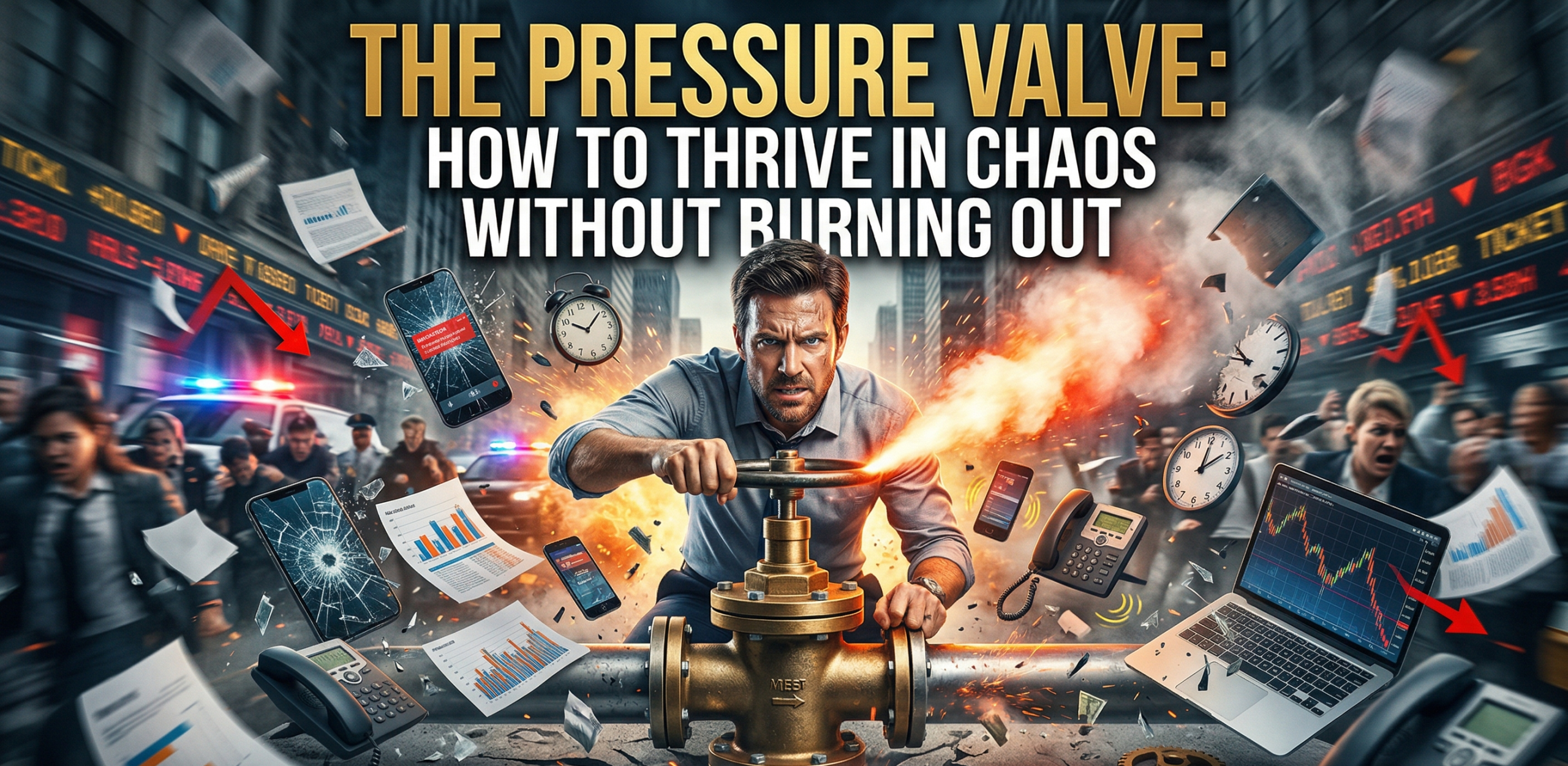
If you want to thrive under pressure, you don’t need to lower the stakes. You need to build a better valve.
The Biology of the “Fumble”
When pressure hits, your body doesn’t know the difference between a missed Q3 target and a predator in the tall grass. It floods your system with cortisol and adrenaline. Your heart rate spikes, your peripheral vision narrows, and—most dangerously—your working memory shrinks.
This is why smart people do “dumb” things under pressure.
When the Amygdala (the emotional alarm) takes over, it “hijacks” the Prefrontal Cortex (the logical CEO). You lose the ability to see the “Big Picture.” You become hyper-focused on the immediate “danger,” which usually results in micro-managing, snapping at colleagues, or freezing up entirely.
Thriving under pressure is the psychological art of keeping the CEO on the phone while the alarm is going off.
Challenge vs. Threat: The Appraisal Shift
In a landmark study by psychologist Wendy Berry Mendes, it was discovered that your physiological response to stress depends entirely on how you label the situation.
- The Threat Appraisal: You view the pressure as something that exceeds your resources. Your blood vessels constrict, your heart works harder but moves less blood, and your performance plummets. You are playing “Not to Lose.”
- The Challenge Appraisal: You view the pressure as a test of your resources. Your blood vessels relax, your oxygen flow increases, and your brain enters a state of “High Arousal” that actually improves cognitive function. You are playing “To Win.”
The “Pressure Valve” is a manual override. When you feel your heart racing, don’t tell yourself to “calm down.” That’s a lie your brain won’t believe. Instead, tell yourself: “I am excited. My body is preparing me for a high-level performance.” By reframing “Anxiety” as “Arousal,” you move the energy from your Amygdala to your Prefrontal Cortex.
Tactical Tools for the “War Room”
You can’t think your way out of a physiological spike, but you can “breathe” your way out of it.
1. The Physiological Sigh
Discovered by neuroscientists, this is the fastest way to lower your heart rate in real-time. Inhale deeply through your nose, then add a second, shorter inhale at the very top to fully inflate the lungs. Then, exhale slowly through your mouth. Doing this twice signals your nervous system to “stand down” immediately.
2. The Rule of Three (Micro-Decisions)
When chaos hits, the “Infinite To-Do List” becomes a paralyzing weight. Shrink the horizon. Ask yourself: “What are the three things that matter in the next 30 minutes?” Ignore everything else. By making micro-decisions, you reclaim a sense of Agency, which is the ultimate antidote to stress.
3. The “Distance” Dialogue
When you’re under pressure, your “Inner Critic” becomes a loud, panicked narrator. Use Third-Person Self-Talk. Instead of thinking “I can’t handle this,” think “[Your Name] is currently navigating a complex situation.” This creates a “Psychological Buffer” that allows you to analyze the problem objectively rather than emotionally.
The “Cooling System” Paradox
The reason most professionals burn out isn’t the “Peak Pressure” moments; it’s the Lack of Oscillation.
High-performance requires high-pressure, followed by High-Quality Recovery. If you stay at a “6 out of 10” stress level all day, every day, your “Valve” eventually fails. You become brittle.
The best “Pressure Players” are those who have mastered the “Drop.” They can go from a 10/10 intensity meeting to a 1/10 intensity walk around the block in minutes. They don’t carry the “heat” of the last task into the next one.
The Final Reframe
Pressure is a privilege. It means that what you are doing actually matters. If there were no pressure, there would be no growth. There would be no “Clutch” moments. There would be no sense of accomplishment. The pressure is the “Resistance Training” for your character.
Stop wishing for an easier life. Start building a stronger nervous system.
The chaos isn’t going anywhere.
The deadlines will keep coming.
The stakes will keep rising.
But you…
You are the one who knows how to use the heat.
Open the valve.
Take the breath.
Step into the fire.
The “New You” is waiting on the other side of the noise.