


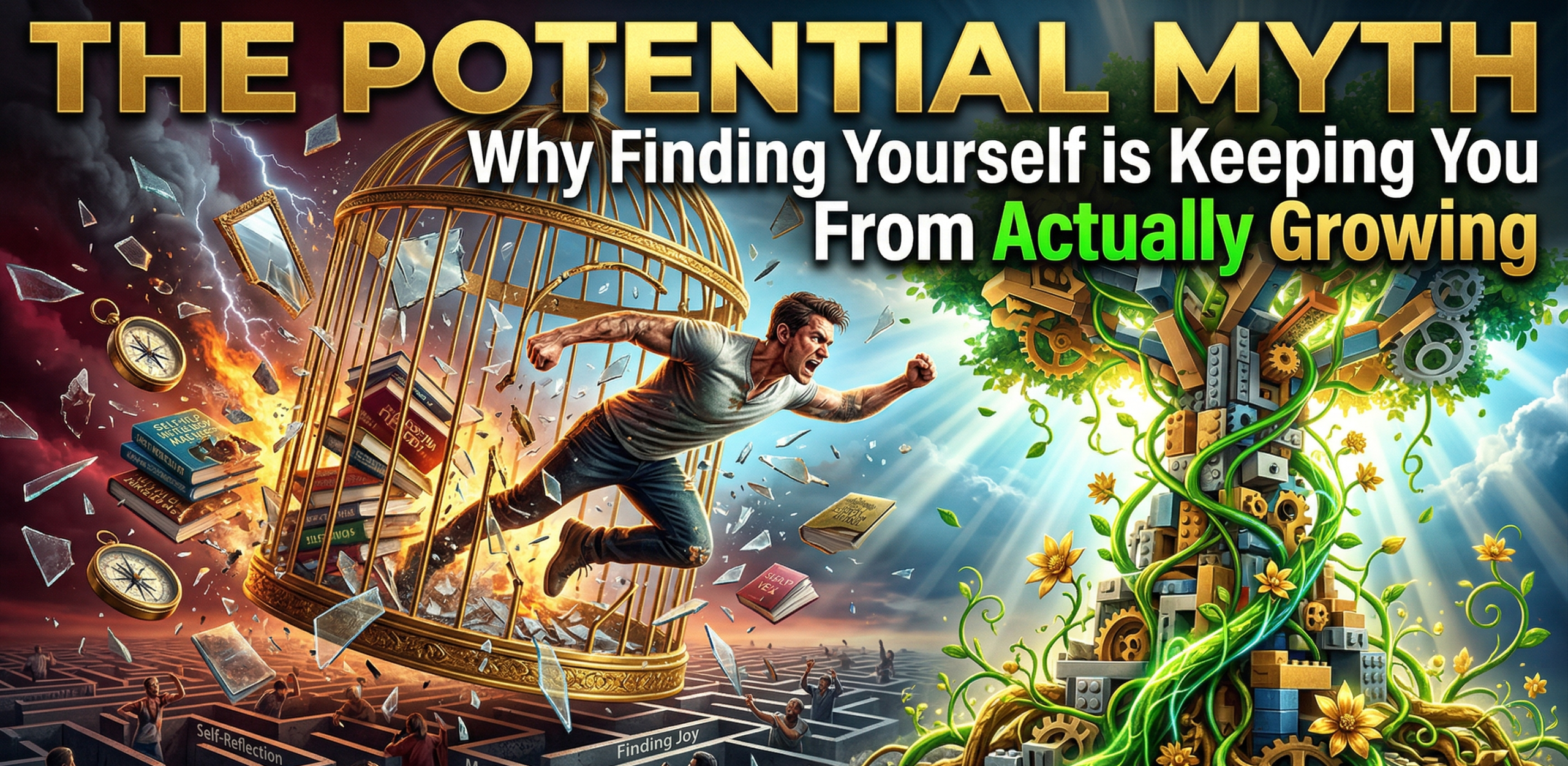
There is a quiet, seductive lie that we tell ourselves whenever we feel stuck.
We tell ourselves that we have “unlimited potential.” We imagine this potential as a shimmering, golden version of our lives that exists just behind a locked door. We believe that if we can just find the right key—the right book, the right mentor, the right “aha” moment—that door will swing open, and we will finally step into the person we were always meant to be.
But here is the brutal reality: The concept of “potential” is often the very thing preventing you from making progress.
Potential is a static concept. It’s a “maybe.” It’s a heavy, abstract weight that creates a gap between who you are right now and some idealized version of who you could be. And the larger that gap becomes, the more paralyzed you feel. You stop moving because you’re terrified that your first real step won’t live up to the “potential” you’ve spent years imagining.
If you want to actually grow, you have to stop trying to “unlock” your potential and start focusing on building your capacity.
The Trap of “Finding Yourself”
We’ve been raised on the narrative of the “Self-Discovery Journey.”
The idea is that your true self is hidden somewhere deep inside you, like a buried treasure, and your job is to excavate it. We spend thousands of dollars and countless hours looking for this hidden “essence.” We travel, we meditate, we take personality tests, and we wait for a sign.
But “finding yourself” is a passive endeavor. It implies that your identity is a fixed thing waiting to be discovered.
Growth isn’t an excavation; it’s an architecture.
You don’t “find” a version of yourself that is disciplined, courageous, or successful. You build it, brick by excruciating brick. When you spend your time trying to “find” who you are, you are essentially waiting for a finished product to appear. But the version of you that achieves your goals doesn’t exist yet. You have to create them through the friction of action.
The Psychology of the Potential Gap
Why does the idea of “having potential” feel so good?
Because it requires zero risk. As long as you have “potential,” you are still a contender. You haven’t failed yet. You can stay in the safety of the “planning phase” forever, comforted by the thought that you could be great if you really tried.
Your brain loves this state. It’s high-reward and low-risk.
But the longer you stay in the potential phase, the more your brain begins to interpret that gap as a threat. You start to feel like an imposter. You look at your daily habits—the scrolling, the procrastinating, the small compromises—and you compare them to the “Potential You.”
The cognitive dissonance becomes unbearable. To cope, you either lower your ambitions to match your current reality, or you retreat even further into the fantasy of “one day.”
Real personal growth begins the moment you stop protecting your potential and start testing your limits.
Capacity Over Potential: The Shift That Changes Everything
Potential is what you could do. Capacity is what you can do, repeatedly, under pressure.
Think of it like an engine. You can have a car with the “potential” to go 200 miles per hour, but if the cooling system can only handle 60, the potential is irrelevant. If you try to push that engine to its limit without building the underlying structure, it will seize.
Most of us try to “unlock” our 200mph potential while we still have 60mph habits.
Building capacity looks like:
- Increasing your tolerance for discomfort.
- Strengthening your “follow-through” muscle on tiny, boring tasks.
- Developing the emotional regulation to stay focused when you’re bored or tired.
- Expanding your skill set so that your “best” becomes your “baseline.”
When you focus on capacity, the “potential” takes care of itself. You stop worrying about whether you’re “living up” to some vague ideal and start focusing on whether you are slightly more capable today than you were yesterday.
The Myth of the “Right Time”
We wait to “unlock our potential” because we’re waiting for the environment to be perfect.
We wait for the kids to be older. We wait for the bank account to be fuller. We wait to feel “inspired” or “ready.”
But readiness is a hallucination.
The brain will never feel truly “ready” to do something that threatens its current comfort zone. Change is an act of aggression against your current identity. If you wait for the feeling of readiness, you will spend your entire life in the waiting room of your own potential.
Growth happens in the “Unready Phase.” It happens when you take a step before you’ve seen the whole staircase. It happens when you commit to a version of yourself that you haven’t actually met yet.
The 30-Day Potential-to-Action Protocol
If you’ve been stuck in the “Potential Trap,” you don’t need a new vision board. You need a new relationship with reality.
Week 1: The Integrity Audit Stop looking at what you could do and look at what you actually do. For seven days, track where your time and energy go. No judgment—just data. You’ll likely find that you’re spending 80% of your energy maintaining a version of yourself that you claim you want to change.
Week 2: Shrink the Target Take one area where you feel you have “unrealized potential.” Now, identify the smallest, most pathetic version of progress in that area. If you have “potential” to write a book, write one paragraph. If you have “potential” to lead a company, lead your own morning routine. The goal is to move from “abstract greatness” to “concrete action.”
Week 3: Lean into the Friction This week, notice the exact moment your brain tries to pull you back into the “potential” fantasy. When you start thinking, “I should be doing more,” or “This isn’t good enough,” stop. Replace those thoughts with: “I am building the capacity to do this.” Focus on the mechanics of the task, not the outcome.
Week 4: The Identity Lock Look at the small wins from the previous weeks. Realize that these wins didn’t come from “finding” yourself; they came from building yourself. You are no longer a person with “potential.” You are a person who acts.
The Final Destruction of the Myth
You are not a seed waiting for the right soil. You are the gardener.
The “Path to Personal Growth” isn’t a hidden trail that you need to find. It’s a road that you pave behind you as you walk.
Stop worrying about whether you’re “unlocking” anything. Stop waiting to discover your “purpose” or your “true self.” These are just distractions that keep you safe from the terrifying work of actually changing.
The version of you that is capable of greatness isn’t hiding inside you. They are waiting for you to build them.
Throw away the key to the door. Tear down the door itself. Start building the staircase.
Your potential isn’t a destination. It’s the byproduct of your courage.