


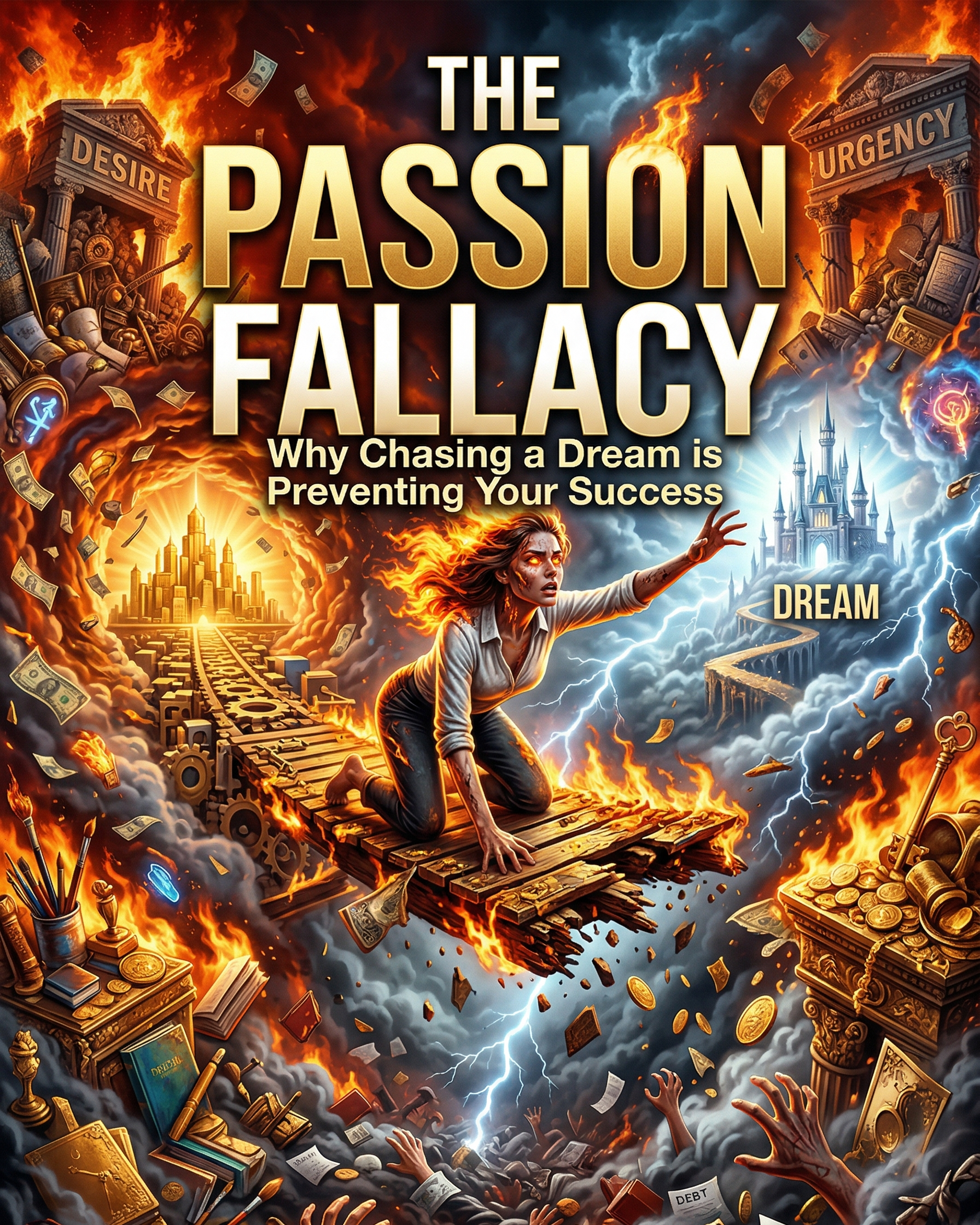
We’ve been fed a steady diet of a very specific, very dangerous kind of folklore.
It’s the “Passion Narrative.” It’s the story of the person who wakes up one Tuesday morning with a bolt of lightning through their soul, realizing they were meant to be a painter, a coder, or a baker. They “follow their heart,” quit their soul-crushing job, and skip off into a sunset of effortless fulfillment and high-digit bank balances.
It’s a beautiful story. It looks great on a Hallmark card.
But for most people, it is a psychological prison.
The Passion Fallacy suggests that passion is a pre-existing condition—something hidden inside you like a dormant organ, just waiting to be discovered. It tells you that if you haven’t found that “one thing” yet, you are somehow broken, or at the very least, behind. So you wait. You hesitate. You sample a hundred different things, waiting for the “spark” to hit.
And when the spark doesn’t hit—when the work feels like, well, work—you assume it isn’t your passion and you move on to the next thing.
This isn’t a “Journey Toward Self-Discovery.” It’s a sophisticated form of procrastination. Because the truth about passion is much less romantic and much more empowering: Passion isn’t the fuel that starts the engine. It’s the heat the engine produces once it’s been running for a long time.
The Burden of the “Grand Calling”
When you believe you have a singular “calling” that you haven’t found yet, every job you take and every project you start feels like a compromise.
You’re constantly looking over the shoulder of your current reality, wondering if the “real” version of your life is happening somewhere else. This creates a state of chronic dissatisfaction. You don’t commit. You don’t go deep. You stay in the shallow end of a dozen different pools because you’re waiting for the one that feels “magical.”
This “Passion Search” actually prevents self-discovery.
You don’t discover who you are by thinking about your interests in a vacuum. You discover who you are by seeing how you respond to the resistance of the world. You find yourself in the struggle, in the boredom, and in the technicalities of a craft.
If you’re waiting for passion to provide the motivation, you’ll never stay with anything long enough to actually find out who you are.
Passion is a Side Effect of Competence
Think back to anything you are currently “passionate” about.
Was it love at first sight? Usually, it wasn’t. Usually, you started doing it because you had to, or because you were slightly curious, or because you were just bored. Then, you got a little bit better at it. You solved a problem. You received a compliment. You saw a tangible result of your effort.
That moment of competence triggered a hit of dopamine.
Your brain said: “Hey, we’re good at this. Let’s do more.” So you did more. You got even better. The challenges got more complex, and the rewards for solving them got more intense. Eventually, people started calling you an “expert.” And suddenly, you felt “passionate.”
Passion is the reward for the work you’ve already put in. It is the psychological byproduct of mastery. If you want to find your passion, stop looking for a “feeling” and start looking for a skill you are willing to get better at.
The “Dream” as a Defense Mechanism
Why is the “Follow Your Passion” advice so popular despite being so ineffective?
Because it’s a perfect excuse for failure.
If you fail at something you “don’t love,” it doesn’t hurt. You can just say, “Well, my heart wasn’t really in it.” The dream remains safe in your head, perfect and unblemished, because you never actually tested it against reality.
But if you commit to something—if you decide to be “passionate” about the boring, difficult, and messy parts of your business or career—you are now at risk. You are exposed.
Self-discovery requires this exposure. It requires you to be the person who tries and fails, rather than the person who waits and dreams. The “New You” isn’t found in a moment of inspiration; they are forged in the moments when the inspiration has run out and you keep working anyway.
The Craftsman’s Path to Self-Discovery
Instead of asking “What am I passionate about?”, the high-performer asks: “What is a problem I am uniquely suited to solve?”
This shift moves you from a “Consumer Mindset” (How can I feel good?) to a “Producer Mindset” (How can I create value?).
When you focus on the problem, you stop obsessing over your “feelings” and start obsessing over your contribution. This is where true self-discovery lives. You learn what you’re willing to sacrifice for. You learn where your natural talents intersect with the world’s needs. You learn how to manage your own frustration.
You aren’t “finding” yourself. You are crafting yourself through the work.
The Litmus Test for Real Interest
If you want to know if you’re on the right path, don’t look for “joy.” Look for frustration.
The things you are truly meant to do are the things that frustrate you in a way that makes you want to fix them.
- If you’re a coder, you’re passionate about the bug that shouldn’t be there.
- If you’re a leader, you’re passionate about the inefficiency that is slowing your team down.
- If you’re an artist, you’re passionate about the gap between the vision in your head and the mark on the paper.
Passion is the energy you bring to the problem. It isn’t a pleasant “vibe”; it is a persistent, focused aggression against mediocrity.
Flipping the Script on Motivation
Stop waiting for a “journey” to begin. You’re already on it.
The path to greatness isn’t paved with “dreams”; it’s paved with discipline. When you stop chasing the “passion high,” you gain a superpower: the ability to be consistent when everyone else is waiting for the “mood” to strike.
And ironically, once you’ve put in the years, once you’ve built the mastery, and once you’ve solved the problems that others ran away from… that’s when the “lightning bolt” finally hits.
You wake up one day and realize you are incredibly passionate about what you do.
Not because it was easy. But because you made it yours.
The “Dream” was a distraction. The work was the discovery. Pick up the tools. The passion is coming—but only if you start without it.