


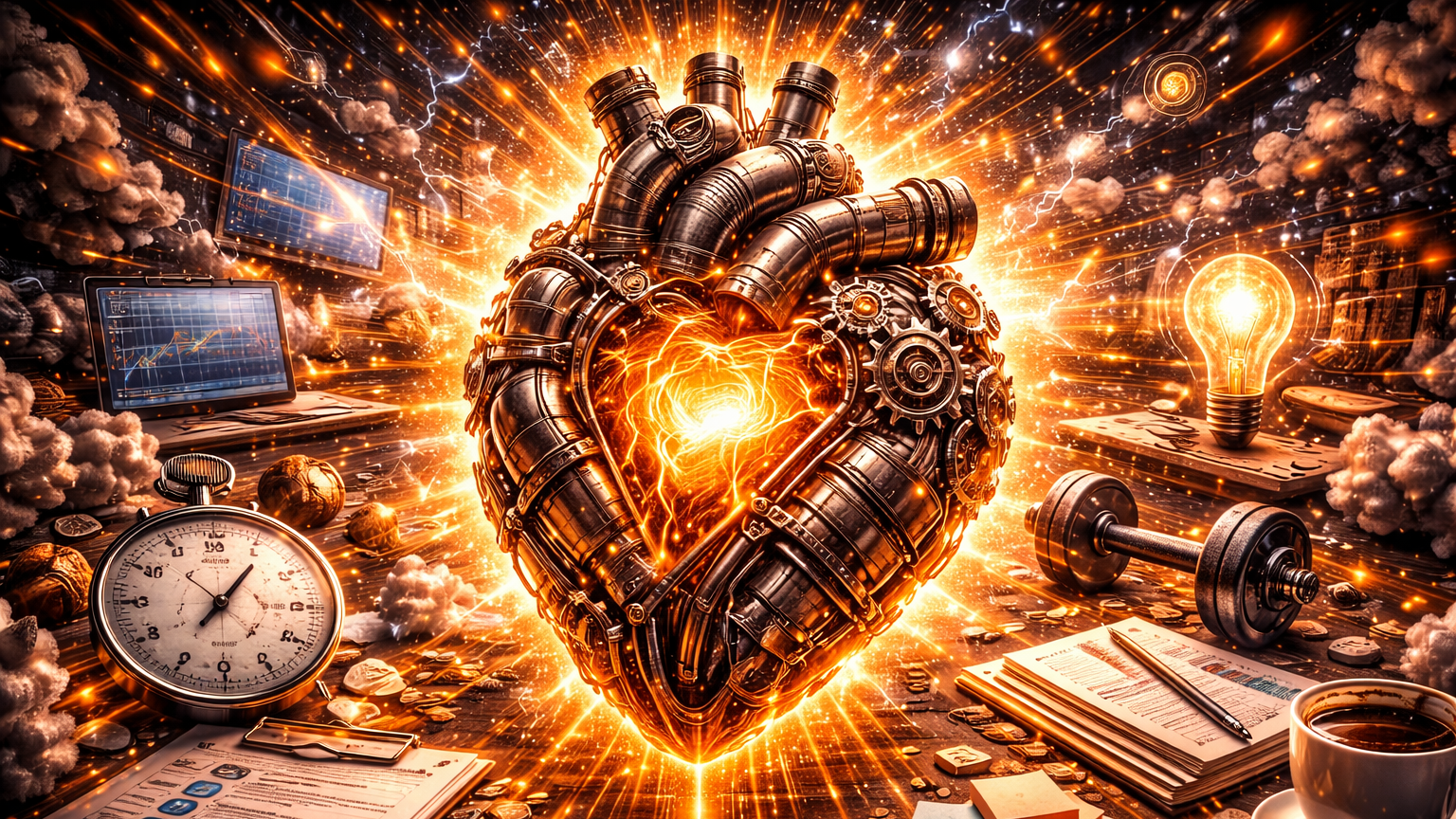
We have a fundamental misunderstanding of how the human “will” actually functions. We treat motivation like a fickle weather pattern—something that either shows up in the morning or doesn’t, leaving us either “inspired” or “lazy.” We spend our lives waiting for the right mood to strike before we tackle the difficult project, start the workout, or have the hard conversation. We act as if motivation is the prerequisite for action.
This is a catastrophic error in biological navigation. In reality, motivation is not the spark that starts the fire; it is the heat generated by the fire. It is an output of a system, not an input. If you are struggling with “laziness,” you don’t have a character flaw. You have a poorly tuned engine. To master self-drive, you must stop searching for a feeling and start understanding the mechanical science of how your brain decides to “Go.”
The Dopamine Delusion: Anticipation vs. Reward
To fix the engine, we have to look at the fuel. In the popular imagination, dopamine is the “pleasure chemical”—the hit you get when you eat a steak or win a bet. But neurobiology tells a more nuanced story. Dopamine is actually the neurotransmitter of craving and anticipation. It is the “Search and Retrieve” signal.
When your brain perceives a potential reward—whether it’s the completion of a task, a social “like,” or a financial gain—it releases dopamine before you act. This chemical surge is what creates the sensation of motivation. It is the fuel that pushes you to cross the room to get the prize.
The problem arises when we “short-circuit” this engine. In 2026, we live in an environment of “Cheap Dopamine.” Infinite scrolling, instant notifications, and hyper-palatable foods provide the reward signal without the requirement of effort. When you spend your morning hit-chasing on a smartphone, you are draining the “Motivation Reservoir” on low-value activities. By the time you sit down to do “Deep Work,” your engine is running on empty. You don’t feel “motivated” because you’ve already spent your daily dopamine budget on digital junk food.
The Mechanic’s Manual: The Three Pillars of Self-Drive
If dopamine is the fuel, your psychological needs are the cylinders of the engine. According to Self-Determination Theory, pioneered by psychologists Edward Deci and Richard Ryan, there are three essential components that must be present for a human to feel sustained, intrinsic drive. If any of these are missing, the engine will sputter, no matter how much “willpower” you throw at it.
1. Autonomy: The Need to be the Author The moment an activity feels “forced” or “mandated” by an outside authority, your intrinsic motivation evaporates. This is why “Work” often feels like a chore even if you used to enjoy the subject matter. Humans have a biological need to feel like they are the “origin” of their actions.
To re-engage this cylinder, you must find “Micro-Autonomy” in every task. Even if your boss assigned the project, you must decide the how, the where, and the order of operations. The more you can frame a task as a “choice” rather than a “requirement,” the more fuel your brain will provide.
2. Competence: The Need for Mastery We are wired to enjoy things we are getting better at. This is why video games are so addictive—they provide a constant, visible sense of “Leveling Up.” Conversely, if a task is too easy, we get bored; if it’s too hard, we get anxious and shut down.
The “Sweet Spot” for motivation is the “Goldilocks Zone” of challenge—roughly 4% beyond your current ability. When you are operating at the edge of your competence, the brain stays engaged because the reward of “Mastery” is constantly within reach. If you are unmotivated, ask yourself: Is the task so easy it’s insulting, or so hard it’s terrifying? Adjust the scope until it feels “optimally difficult.”
3. Relatedness: The Need for Purpose No engine runs for long in total isolation. We need to know that our effort “matters” to someone other than ourselves. This isn’t about “fame”; it’s about “Utility.” When you can see the direct line between your effort and the benefit to a client, a teammate, or a family member, your brain unlocks a secondary reservoir of “Social Energy.” Purpose is the ultimate stabilizer for the motivation engine. It keeps you moving when the “fun” of the task has worn off.
Engineering the Environment: Friction vs. Fuel
Most people try to increase motivation by “trying harder.” This is like trying to make a car go faster by pushing the speedometer needle with your hand. It doesn’t work. Instead, you must look at the Friction in your environment.
Every task has an “Activation Energy” cost. If you want to go to the gym, but your shoes are in the closet, your gym bag is unpacked, and you have to find your keys, the “Friction” is high. Your brain calculates the cost-to-benefit ratio and decides it isn’t worth the dopamine spend.
High-performers don’t have “more” motivation; they have lower friction. They design their environment so that “Starting” requires zero thought. They pack the bag the night before. They clear the desk of distractions. They open the relevant software files before they go to sleep. They “Grease the Wheels” so that the engine can turn over with the smallest possible spark.
The Identity Loop: From “Doing” to “Being”
The final, most powerful secret of the Motivation Engine is the shift from Outcome-Based Motivation to Identity-Based Motivation.
Outcome-Based: “I want to lose 10 pounds.” (The engine stops once the goal is hit or missed). Identity-Based: “I am the type of person who never misses a workout.” (The engine is part of the hardware).
When an action is tied to your “Self-Definition,” motivation becomes irrelevant. You don’t “motivate” yourself to brush your teeth in the morning; you just do it because you are a person who practices basic hygiene. When you shift your focus from the “Result” to the “Repetition,” you are building a permanent engine. You stop asking “Do I feel like doing this?” and start realizing “This is just what I do.”
The Daily Calibration
To keep your Motivation Engine running in 2026, you must perform a daily audit:
- Protect the Fuel: Delay the “Cheap Dopamine” (phones, news, sugar) until after your most important task is done.
- Lower the Friction: What is the one thing I can do tonight to make “Starting” tomorrow morning automatic?
- Check the Cylinders: Do I feel like I have a choice (Autonomy)? Is this task the right level of hard (Competence)? Who does this help (Relatedness)?
Motivation is not a mystery. It is a biological consequence of specific conditions. Stop waiting for the spirit to move you. Build the engine, fuel it correctly, and clear the tracks. The movement will follow the mechanics. The spark is waiting for you to turn the key.